TRAIL OF TEARS STATE FOREST
Trail of Tears, one of Illinois' state forests, is situated in western Union County, five miles northwest of Jonesboro and 20 miles south of Murphysboro. Just over 5,000 acres are within the State Forest.
The State Forest System in Illinois was established to set aside lands for the growing of timber needed in production of forest products, for watershed protection and to provide outdoor recreation. Trail of Tears State Forest is a multiple-use site managed for timber, wildlife, ecosystem preservation, watershed protection and recreation.
Trail of Tears State Forest lies within the southern section of the Ozark Hills, one of the most rugged landscapes in Illinois. The hills are composed of chert (a weathered limestone residue). Soils are shallow and susceptible to erosion. Ridge tops are narrow, rocky, and dry. Clear streams with gravel bottoms are in the narrow forested valleys, hemmed in by the steep terrain.
The variety in plant communities is influenced by the terrain. Dry ridgetops and south-facing slopes have black oaks, white oaks and hickories. Extremely dry sites contain prairie-like openings (barrens and hill prairies) with a mingling of gnarled open-grown trees and shrubs like wild azalea, farkleberry and low-bush blueberry. The shaded north-facing slopes and protected coves support stands of American beech, tuliptree and sugar maple, or red oak, tuliptree and sweetgum. A rich understory of shrubs (including pawpaw, buckeyes, bladdernut and hornbeam), exists in moister sites. In stream valleys, a canopy of American elm, sweetgum, tuliptree, sycamore and sugar maple over a shrub layer of redbud, deciduous holly and spicebush, and thickets of wild cane (bamboo) occur. The wildflower flora of the Forest's lower slopes and valleys is lush and diverse. On a walk in the spring, a visitor can see many of the woodland wildflowers native to southern Illinois. In all, 620 species of flowering plants, ferns and fern allies are reported to occur at the State Forest.
There are many species of songbirds, including those restricted to large woodland tracts. Two species of poisonous snakes, timber rattlesnakes and northern copperheads, occur here. They are no danger to cautious visitors and must be left as part of the Forest's natural environment; indiscriminate killing of snakes is prohibited. Woodland mammals such as fox and grey squirrels, chipmunks, flying squirrels, opossums, skunks and raccoons, are common. Larger mammals known to inhabit the Forest are whitetailed deer, red and grey foxes, coyotes and the wary bobcat.
Forestry:
One of Illinois' two plant propagation center, the Union State Nursery, occupies 120 acres of the Forest. Approximately 10 acres of the nursery are devoted annually to growing nursery stock. The Nursery produces up to 3 million seedlings a year! Certain tree plantations within the Forest are seed sources for producing genetically superior stock.
The Forest is divided into 27 management compartments where the relationships of different timber harvest techniques to production of forest materials and their effects upon ecosystem function are studied. Although proceeds from those sales help support related programs at this and other State sites, research and education use of timber sites on the State Forest have a value far beyond any monetary gain from timber sales.
Wildlife:
Woodland openings are managed to provide food and cover for upland game species and those small mammals which are important food for predators. Some areas are planted in small grains; others are burned or mowed to maintain grassy habitat for nesting birds and the insects upon which they feed. Hollow trees are left for cavity-nesting wildlife.
The area was used extensively by prehistoric Native Americans. Individuals and small groups hunted game or gathered nuts within the Ozarks, but established their settlements closer to the Mississippi River or Clear Creek. Chert was mined (for making tools) at Iron Mountain, east of the Forest.
As settlers of European descent entered (around 1803), Native Americans were pushed south and west. In 1838-39 the Cherokee, Creek, and Chickasaw nations were forced by the U.S. Army to move from the southeast to reservations in Oklahoma Territory. They overwintered at makeshift camps 4 miles south of the Forest's southern boundary. Bitter cold and starvation claimed hundreds of lives. The cruel trek came to be known as the "Trail of Tears." The State Forest's name memorializes the tragic event.
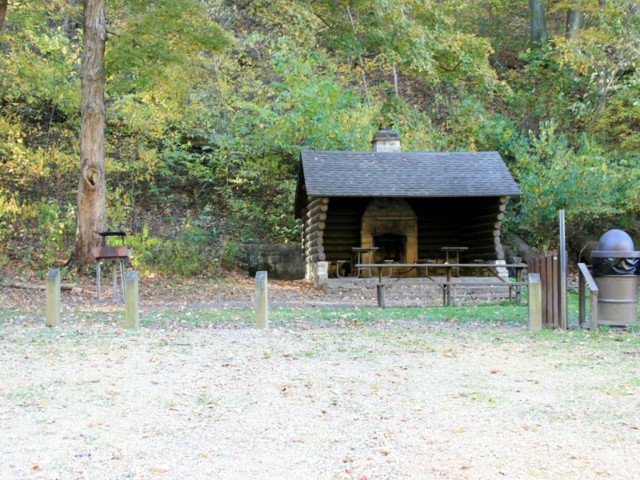
In 1929, the State purchased 3000 acres as the Kohn-Jackson Forest, later named Union State Forest. During the 1930's the Civilian Conservation Corps (CCC) camp operated in the Forest. The CCC constructed many of the stonework stabilization walls and log stone shelters within the picnic area and along the Forest roads.
The Trail of Tears State Forest of today encompasses 5114 acres administered by the Division of Land Management. The nursery is operated by the Division of Forest Resources.
- T Walker
Both Class C (tent camping with vehicle access) and Class D (backpack) camping sites are available at the State Forest. Some locations have log shelters with adjacent privies. Group camping is available at a few sites. The forest's gravel roads are closed to vehicles from December 24 through the end of the spring wild turkey hunting season (generally the second week in May). All camping access is by foot only during that period (Class D). For information on group camping or special access concerns (during the winter-spring months) contact the site superintendent headquarters at (618-833-4910).

Cottages and Cabins
Doc's Lakeside Cabin was built in 2012 and is located in beautiful Southern Illinois. Let us welcome you to setting where you can rejuvenate your mind, body and soul.
4 miles from park*

Cottages and Cabins
Top notch accommodations on the Shawnee Hills Wine Trail and on the edge of the Shawnee National Forest.
12.6 miles from park*

Cottages and Cabins
Tucked away in the picturesque rolling hills of Southern Illinois, our location rests on the highly acclaimed Southern Illinois Wine Trail. Pinnon Lake cabins are ten tranquil minutes from the edge of Shawnee National Forest. Moments from anywhere yet feels like miles from it all.
12.8 miles from park*





 This is a beautiful place with many hiking trails. I love to run around.



 Share Your Trail of Tears State Forest Photos (click here)