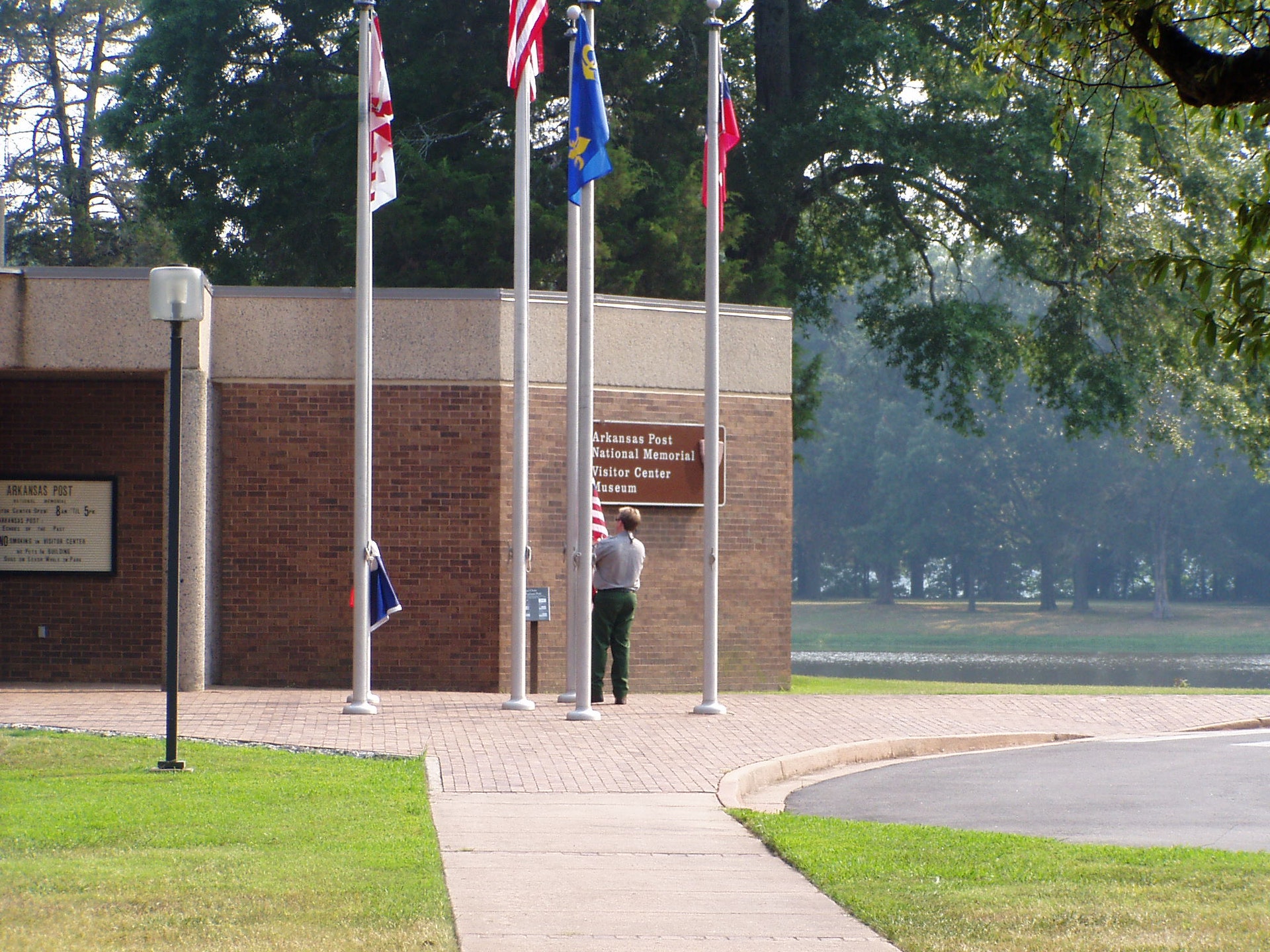
ARKANSAS POST NATIONAL MEMORIAL
In 1686, Henri de Tonti established a trading post known as "Poste de Arkansea" at the Quapaw village of Osotouy. It was the first semi-permanent French settlement in the lower Mississippi River Valley. The establishment of the Post was the first step in a long struggle between France, Spain, and England over the interior of the North American continent.
Over the years, the Post relocated as necessary due to flooding from the Arkansas River, but its position always served of strategic importance for the French, Spanish, American, and Confederate military. Spanish soldiers and British partisans clashed here in the 1783 "Colbert Raid," the only Revolutionary War action in Arkansas.
Arkansas Post became part of the United States following the Louisiana Purchase of 1803. By 1819, the post was a thriving river port and the largest city in the region and selected as the first capital of the Arkansas Territory.
During the Civil War, Confederate troops tried to maintain tactical control of the confluence of the two rivers, and in 1862 they constructed a massive earthen fortification known as Fort Hindman at the Post. In January 1863 Union troops destroyed the fort, ensuring control of the Arkansas River.
Today, the memorial and museum commemorate the multi-layered and complex history of the site. Located on a peninsula bordered by the Arkansas River and two backwaters, the site offers excellent fishing and wildlife watching opportunities.
Animals:
On the edge of the Arkansas River and the Grand Prairie, Arkansas Post is home to a diverse animal population. Whitetail deer can frequently be seen throughout the park, while other species are not as easily seen. Racoons and opossums also reside in the forested sections of the park.
The most notable non-native species residing in the aprk is the nutria, an aquatic mammal similiar to beaver. Introduced to North America in the early 20th century, the nutria [Myocastor coypus] quickly spread from Louisiana along various waterways, including the Mississippi and Arkansas rivers.
Throughout the 18th and early 19th centuries, the settlement at Arkansas Post was the base for fur-trapping activities along the Arkansas, White, and St. Fransis rivers. The animal population in the park today serves as a reminder of the seemingly unlimited animal populations that attracted hunters over 150 years ago.
Plants:
The land-based portion of the park, 117 hectares, is characterized by terrace landscapes, flat terrain, and various stands of upland and lowland hardwoods. Bayous and swamps are interspersed throughout the area. Manicured lawns, prairie, and tall-grass areas also exist within the Park. As such, an abundance of flora and fauna resides both on land and in water. Moore Bayou and Post Bayou lie along the north/northwest border and Post Bend Lake, a backwater of the Arkansas River, lies on the north and northeastern border. Both bayous, as well as the backwater, empty into the Arkansas River, which borders the southern edge of the Park. Arkansas Post is the site of over 300 years of European occupation. Consequently, the land-based portion presents a mosaic of different successional stands. Of the twelve general vegetation types delineated, the Superintendent has designated five (excluding mowed areas) as high visitor use areas. They are the oak/pine, oak/hickory, oak/mixed, sweetgum, and tallgrass types.
Arkansas Post's three-hundred year history is a rich and complex story. Diverse peoples, including the Quapaw Indians, European explorers such as De Soto and La Salle, hunters and traders all contributed to making Arkansas Post an important frontier outpost from the 1680s to the late 1700s. Transferred to the United States in the Louisiana Purchase, Arkansas Post was transformed from a sleepy French community to a bustling town during the two years it served as capital of the Arkansas Territory.
While little visible remains of this vibrant place in American history survive, Arkansas Post has many stories to tell. The following links explore various aspects of the history of Arkansas Post:
Day-UseFishingyes
Hiking Trailyes
Picnickingyes





 The park is beautiful and very well kept. The staff are helpful and talkative. Easy to approach. The battlefield only shows part of where the battle of Fort Hindman was fought. The river has claimed the fort and it has changed course so it is difficult to really get a grasp of what happened inside the fort. The battle for the rifle pits is easier to understand as it still exists. I would like to see more signs like those as Vicksburg that show where the different units were located and a description of what happened in the pits.
I have been at the post at night and even during the day you can still feel the people who lived there. Winter is the best time to go because being in woods ticks can latch onto you and have me. It still is wonderful place and very peaceful.
The park is beautiful and very well kept. The staff are helpful and talkative. Easy to approach. The battlefield only shows part of where the battle of Fort Hindman was fought. The river has claimed the fort and it has changed course so it is difficult to really get a grasp of what happened inside the fort. The battle for the rifle pits is easier to understand as it still exists. I would like to see more signs like those as Vicksburg that show where the different units were located and a description of what happened in the pits.
I have been at the post at night and even during the day you can still feel the people who lived there. Winter is the best time to go because being in woods ticks can latch onto you and have me. It still is wonderful place and very peaceful. I grew up the Road at Clarendon and this was the first visit with my wife. The State and National parks staff are very friendly and the park is beautiful.



 Share Your Arkansas Post National Memorial Photos (click here)